Tuesday, 3 May 2016

Rainwater Harvesting


 Rainwater Harvesting


Water is the gift of God for use of all. It is one of the basic needs for survival. In villages there are deep wells, shallow wells and ponds that clearly point to the high priority the ancients gave for water conservation. With large scale and haphazard urbanization, the values of simple and effective traditional techniques of water conservation were ignored. Now the people have realized these values and are taking steps to revive the old and trusted techniques.

For centuries rivers and tanks met the drinking water and irrigation needs of the people. In those days people living far away from the river course and wetlands conserved rainwater in large walls and regulated the rainwater to fall into ponds and lakes. During the summer months they utilized the stored rainwater for drinking and irrigating thousands of acres of agricultural land. The community controlled the water use.

Rainwater does go waste if it is not properly regulated. Cheerapunji  in Assam receives almost 12,000 mm of rainfall per annum, yet people there face drinking water scarcity while in arid Rajasthan it hardly rains for a month. However, the industrious villagers store rainwater in large natural and manmade reservoirs by adopting rainwater-harvesting techniques for use during the months of scarcity.

Tanks and ponds that adorn the villages are now shrinking in numbers. Many water bodies are facing the threat of extinction. Natural reservoirs have slowly been fading away due to encroachment, land grabbing, and poor planning.

In urban areas, concrete buildings and asphalted roads prevent water from seeping into the ground. When it rains the rainwater just gushes out into the drains. Because of this the ground water is not replenished and the water table does not rise.

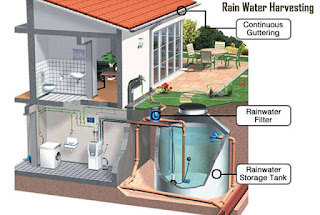
The need for conserving rainwater is now more vital than ever before. In these days of water scarcity the traditional techniques must be revived for saving precious water. Rainwater Harvesting (RWH) is the technique of collecting and storing rainwater wherever it rains instead of allowing it to go waste. Rainwater recharge is a method to increase rainwater infiltration in the soil surface to raise the ground water table.

How to conserve rainwater? Collecting water from the rooftops through pipes and discharging into we11s, recharging of defunct bore wells and open wells through percolating pits, regulating it to flow into ponds and lakes are some of the efficient and cost effective methods to augment water supply.

The cost of making percolating pits around a 100 sq m house with filter tank and underground pipe leading to the well works out to approximately·Rs.6000/-. For a 20 m x 30 m multistoried building the cost of making 1 m x I .5 m deep percolating pits around it with drain pipes, filter tank and underground piping to the well will be around Rs.75, 000/-. For row houses and businhouses complexes it works out to approximately Rs.2, 00,000 and Rs.90, 000 respectively.

An independent house in Bangalore can on an average save about 40,000 liters of rainwater per year after meeting all the needs. Rainwater conservation augments ground water level; raises water level in the existing wells; re- charges defunct bore wells and open wells; prevents cracking of building walls due to presence of moisture in the soil; decreases the salinity of soil and increases the quality 'of ground water and the moisture content of the soil; increases soil fertility due to growth of vegetation; stops seepage of seawater into the ground water; stops soil erosion Conserving rainwater not only solves the drinking water problems the people face during the summer months, but also irrigates several acres of agricultural land in draught affected areas.

While granting license to construct new buildings the authorities must ensure that the building plan has provision for rainwater harvesting. If it is not provided, then the authorities shall not grant license to the builders.
This is not sufficient. Government's propaganda machinery must galvanize in to action to popularize this inexpensive and very efficient technique of water saving concept.

Lakes must be de- silted and deepened to hold more water, In villages too this concept must be popularized. The World Bank has warned of severe drinking water scarcity in India in the year 2025. Scanty rainfall in the recent years is perhaps indicating the shape of things to come. It is high time government acted with all seriousness to ward off the impending disaster. Having a green belt without any water scarcity is known as a blue belt area, that is when we recharge the ground water and change the conditions of a place from one of scarcity of water to one of sustenance. This can be achieved through RWH techniques and this will save Bangalore from water scarcity. Bangalore's topography is particularly suitable for rainwater harvesting.

 The and the granite rock underneath are well suited for RWH. These are unique qualities and it should be tapped to the maximum. Also Bangalore gets about 850 mm rainfalls annually. This gift from Mother Nature shall not go down the drain.

Though about 700 million liters of water from Cauvery and other sources are being generated daily, yet there is a wide gap between supply and demand. At current rate of consumption, the city needs additional 150 million liters daily. In a few years from now water supply as high as 2200 million liters daily would be needed. RWH is a less expensive affair. Anyone can adopt this technique.

Government buildings, large educational institutions, hospitals, satellite ownships, condominiums and independent households must adopt this technique. In so doing, water scarcity during the summer months can be contained to a great extent. Reports say that government is preparing action plans in all districts to tackle the problem of drinking water shortage on account of failure of monsoons. There are about 56,000 villages and hamlets in the state, which face drinking water crisis one time or the other. The problem accentuates when there is scanty rainfall.

For More...........:


Monday, 2 May 2016

Tree Planting


 Tree Planting


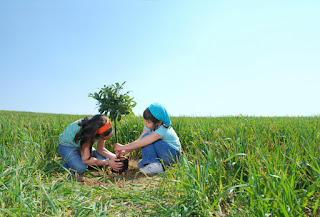
To mitigate hazards due to global warming, tree planting is to be encouraged. Tree lovers are struggling hard to retain trees affected from road widening by Bruhat Bangalore Mahanagar Palike (BBMP). They are organizing agitations, preventing persons entrusted to cut trees, and arguing with BBMP authorities. This happened a few years back when  BBMP commenced widening of Sankey Road by removal of well grown trees.  Similar agitations were held for widening of  Sampige Road and road along Bangalore Palace. The Sankey Road residents were even arrested and later released . Their interest is not to affect environment by removal of trees, is to be appreciated. Sankey Road residents are showing the way to residents of other parts of the city to protect trees in their respective localities. Such active citizens should be honoured for their good citizenship. Such devoted people should be elected as corporators  and legislators in the interest of improvement of the city. There should also be awareness for proper footpaths for use by pedestrians, pedestrian crossings, rejuvenation of vanishing lakes, etc.

BBMP may review its road widening program to see whether all the roads proposed for widening are required to be widened in view of the introduction of Metro Rail and proposal  to take up Mono Rail networks, and bus transport as feeder service. Road traffic is expected to be less by about 40% after such multi-modal transportation is introduced. There is also a proposal by the Railways to introduce Suburban Rail to help the commuters.  The efforts of some European cities is to  create hardship for movement of private vehicles by prohibiting private vehicles in the central business district during peak hours, and levy of congestion tax for movement of private vehicles in the central area. The idea is to force  the citizens to use  mass transportation. But, we have to consider such policies only after effective provision of metro rail and mono rail net works and not till then.

Some of the architects and builders interested in improving urban environment are providing vertical gardens  in tall structures and on terraces. More and more instances of civic awareness are likely in future due to environmental degradation, global warming, etc. affecting living conditions.

The good living conditions in earlier times with sincere administration in providing parks and tree planting for the benefit of people is mentioned herein. We have read in history books about the good administration by some rulers. It is mentioned among their achievements in the administration that the rulers formed avenues with trees and formed parks. The capital cities of the earlier rulers have roads with tree planting, good parks, landscaping, boulevards, public buildings with good landscaping, etc. Mysore, Delhi, Jaipur are examples of such cities. New Delhi developed by British rulers is an example of good roads with trees, parks, landscaping around heritage structures, etc.  Moghul Kings contributed a lot for landscaping in their palaces and premises of heritage buildings. Even industrialists like Tatas have contributed to good tree planting in city like Jamshedpur. Hyder Ali developed Lal Bagh in Bangalore. During the Britishers rule, Cubbon Park was developed. Bangalore Palace area is another example of good tree cover around Palace building. Role of former army officers is to be appreciated for forming good cantonment areas providing wide roads with tree planting, parks and playgrounds, etc. Cities like; Bangalore, Belgaum etc, are examples of good urban development by army officers. Le Corbusier is remembered for his valuable contribution in the design of Chandigarh City where one third of the city area was used for forming parks, gardens, avenue trees, green strips, urban forestry, etc. Adequate provision for  green spaces are made  in Chandigarh for good environment.

In Singapore, green corridors are developed connecting parks and natural valleys. In Sao Paulo, Brazil, private sector is involved under public-private partnership to plant trees and monthly progress in tree planting reviewed. Such policies and programs are required to be introduced in large cities of India in the interest of improving environment.

BBMP has  its own Horticulture Section . Most of the park areas  reserved in BDA extensions and enforced in private layouts are lying as vacant spaces where debris and garbage are dumped.  There are instances of encroachment also in the neglected park areas. BDA may develop the park areas  before handing over its layouts and private  layouts to BBMP for maintenance.

The Horticulture Department and the Forest Department may also take up parks/mini forest projects in  Bangalore to contribute towards bringing back the name of Garden City. Tree planting may be taken up in wider roads formed by BDA like Outer Ring Road  and other roads.

In view of Global warming and indifferent weather conditions, serious action is necessary by civic agencies as well as private sector developers, builders,  and Corporate companies to provide tree planting  as much as possible in their projects.

The Karnataka High Court observed during November, 2014, that the state administration is not aware of the number of trees in Bangalore, how much green space is lost in the recent years to make way for high-rise buildings and infrastructure projects. The Honourable  Court  directed the State government to constitute  a ‘Tree Authority’ under section 3 of the Karnataka Trees Preservation Act,1976. It was directed that the Authority has to closely examine every tree before it is fell. The aim is to ensure transparency, reduce air pollution, and maintain greenery. This was reported  in Deccan Herald news paper dated 13-11-2014. It was mentioned in the press report that BBMP formed earlier two committees separately for Bangalore North Taluk and Bangalore South Taluk, but they have not met even once till date. Environmental experts  commented  that such lapses in governance is unfortunate. As the effects of Global warming is bad, Government should monitor actions by BBMP for improving greenery. 


Earlier, 15% of the layout area was reserved for parks and open spaces in BDA extensions as well as private layouts. But, in the Master Plan – 2015, the provision was reduced to 10%. Due to this, the result is more of concrete surfaces and less of open spaces. At least, the same percentage or more should have been maintained in the interest of mitigating the hazards of deteriorating environment. Why not they follow the example of Singapore, Kuala Lumpur, Sao Paulo in Brazil, and Chandigarh, etc. Master Plan-2031 which is under preparation by BDA , should make higher provision for parks and open spaces. It should be 15% of the layout area, this has to  be ensured by Government while according approval to the Master Plan-2031.


1.   Parks
2.   Boulevards
3.   City roads and highways
4.   Boundaries of playgrounds
5.   Open spaces in public premises
6.   Lands not fit for building purposes
7.   Green Belt (Agricultural Zone)
8.   Natural valley margins, and
9.   Apartments, and commercial complexes.


1. The National Urban Housing and Habitat Policy, 2007 states that “It will be desirable to pursue a goal of 20-25% recreational land use area (excluding water bodies) which has been prescribed for metropolitan cities by the Urban Development Plan Formulation and Implementation (UDPFI) Guidelines in order to improve environment in large cities. This policy is to be enforced strictly by making adequate provisions for parks and open spaces in the master plans, and building byelaws. In BDAs Master Plan-2015 the UDPFI guidelines are not followed. At least in the next master plan, UDPFI guidelines may be followed.

2. Concessions in property tax may be introduced for every tree planted and maintained after the trees are maintained and grown up.

3. Hierarchy of road network may be planned to provide for adequate width for tree planting. In any road widening scheme, the existing trees should not be cut but additional traffic lanes provided by taking over road margin areas.

4. In some commercial complexes, trees are removed in  the  frontage of the complex for  parking of their vehicles.  This should be prohibited and only entry of vehicles through a gate be allowed.

5. Trees are removed for road widening, transmission lines, etc. Double the number of trees removed should be planted and maintained.

6. Bangalore Palace declared as taken over by government under The Urban   Land Ceiling Act, 1976 earlier, and is said to be under litigation, may be provided with lot of tree cover to enable citizens to use it as a Third City Level Park in addition to Lal Bagh and Cubbon Park.

5. Government lands in Bangalore Metropolitan Area may be developed as tree parks/urban forests including the government lands after clearing the encroachments.

6. The Comprehensive Development Plan (CDP)-1984, provided  two thirds of the Metropolitan Area  reserved as Green Belt.   In future master plans, areas for  further urbanization may be proposed beyond the Green Belt with good connectivity instead of reducing the Green Belt area reserved already in the earlier master plans. 
7. The buildings allowed as permissible uses in the Green Belt area with 20% of the land as built up area with ground and one floor may be discontinued as it is observed that later without effective enforcement, violations are made increasing the built up area. It is suggested that buildings may be completely prohibited in the Green Belt area.

8. For improving the beauty of the cities, Corporate companies may be involved to adopt particular roads for beautification with tree planting  by allowing limited advertisements for  their own purpose.


For More...........: